
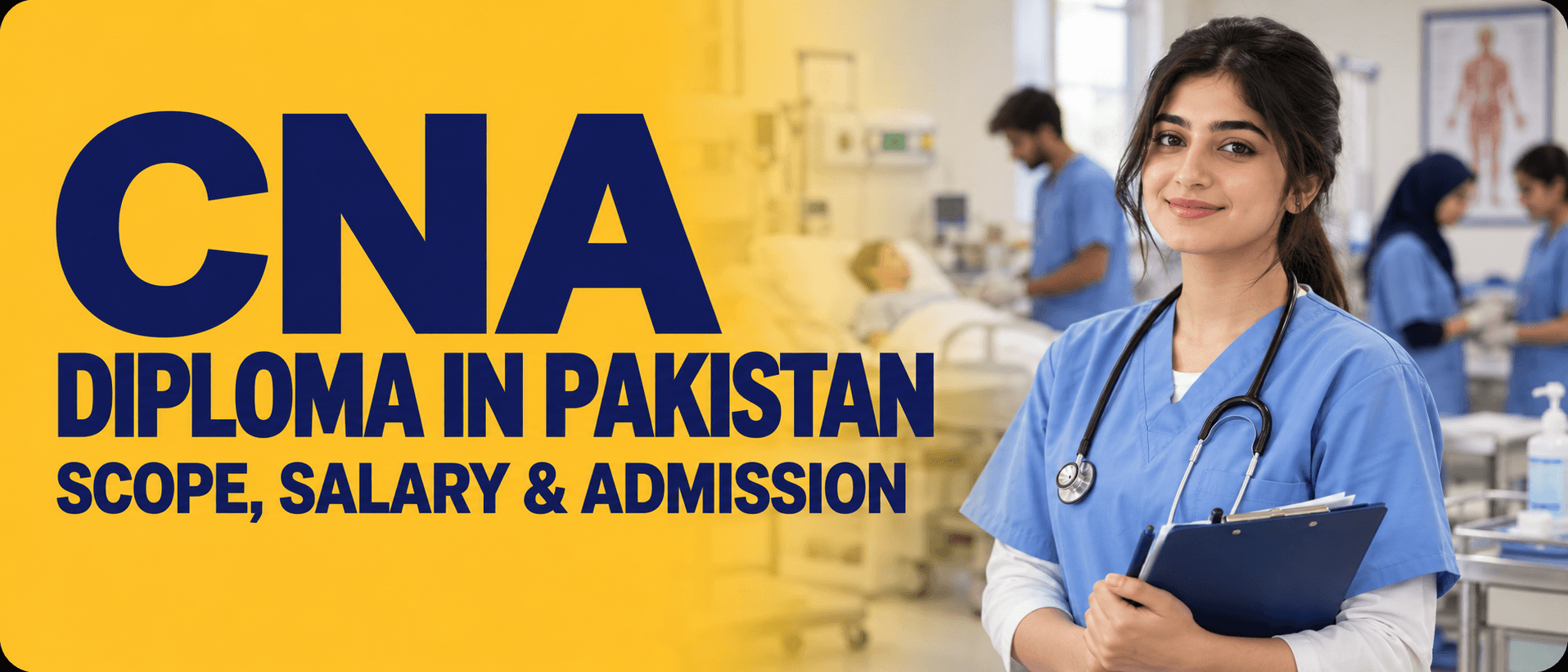
CNA diploma in Pakistan is a two-year qualification that trains graduates to work as Certified Nursing Assistants — providing hands-on patient support in hospitals, nursing homes, home health settings, rehabilitation centers, and clinics across the country.
Not everyone who wants to work in healthcare wants to spend four years on a BSN. That’s where CNA fits. It’s a shorter, more direct route into clinical environments — focused on patient support rather than independent nursing practice. You’re not learning to run a ward. You’re learning to work effectively inside one, supporting the clinical staff who do.
At UChenab University Gujrat in Gujrat, Punjab, Pakistan, the CNA diploma is accredited by the Pakistan Nursing Council (PNC). Students from FSc Pre-Medical and Matric Science backgrounds are the core applicants, though the program also has a route for Arts and FA students through an entry test.
What Is the Scope of CNA Diploma in Pakistan in 2026?
The scope of CNA diploma in Pakistan covers hospitals, private clinics, nursing homes, home health services, geriatric care facilities, rehabilitation centers, and community health programs — and all of these settings hire regularly.
Here is what drives that demand. Registered nurses and doctors cannot personally carry out every routine bedside task for every patient throughout a shift. Monitoring vitals, helping patients move, assisting with hygiene, maintaining patient comfort — someone has to do this work, and in a structured healthcare environment, it is the nursing assistant’s job. That reality does not change regardless of how advanced a hospital gets. If anything, as Pakistan’s private healthcare sector grows, demand for trained support staff at this level grows alongside it.
Where CNA scope is different from a BSN graduate’s scope is in the nature of the role. A nursing diploma Pakistan at the CNA level prepares you for patient support and care assistance — not independent clinical decision-making. Knowing that distinction before you apply matters, because it determines whether CNA is actually the qualification you need or whether you’d be better served by going straight for a four-year BSN.
For students who know they want healthcare work and want to get there in two years rather than four, cna scope in pakistan across the private sector is genuinely accessible.
CNA Career Paths in Pakistan — What Can You Do After the Diploma?
Career outcomes after a CNA depend heavily on where you work, who your employer is, and what skills you keep building after graduation. The paths below are not a guaranteed menu — they reflect the range of roles that CNA training makes accessible.
Direct Patient Care
The most immediate career path is working as a Certified Nursing Assistant in a hospital or clinical facility. Day-to-day responsibilities include assisting patients with mobility, supporting personal hygiene routines, observing and recording basic patient conditions, and relaying relevant information to the nursing team. It is hands-on, often physically demanding work that puts you at the center of patient experience rather than on the administrative edges of it.
Patient Care Technician is a closely related role. Depending on the employer and facility type, technicians take on bedside support tasks while working within defined clinical boundaries. Some organizations use these titles interchangeably; others draw clearer distinctions between CNA and PCT responsibilities. Reading the actual job description matters more than the title.
Specialized Care Settings
Geriatric Care Aide work focuses on elderly patients — often in long-term care facilities where residents need consistent daily assistance with movement, hygiene, comfort, and routine activities. Pakistan’s urban population is aging, and private geriatric care facilities have been growing as a result — creating steady demand for trained care staff in this area.
Hospice Aides support patients in palliative care situations, where the clinical picture has shifted toward comfort and dignity rather than treatment. This is emotionally demanding work that requires a different kind of attention than a busy hospital ward.
Home Health Aides provide patient care in domestic settings — visiting patients recovering from hospitalization, supporting elderly individuals living independently, or assisting people with chronic conditions who don’t require full-time inpatient care. Private home care in Pakistan’s urban areas has expanded as a healthcare delivery option in recent years, creating demand for qualified care workers who can operate outside institutional settings
Support and Coordination Roles
Medical Assistant and Healthcare Support Worker roles vary considerably by employer. Some involve clinical support tasks — preparing patients for examinations, taking vitals, assisting clinical staff with procedures. Others are more administrative, coordinating patient flow, managing records, or supporting clinical departments operationally. A CNA background makes both more accessible.
Rehabilitation Aide work sits alongside physical therapy teams, helping patients with exercise routines, mobility practice, and day-to-day recovery activities. The CNA’s patient-handling knowledge transfers directly into rehabilitation settings.
A Note on Advanced Career Paths
Emergency Medical Technician and Clinical Care Coordinator are listed among the broader career directions CNA training can eventually connect to. But these should not be read as automatic next steps after the diploma. EMT work requires dedicated emergency-care training separate from what a CNA program delivers. Clinical coordination roles typically develop from years of practical healthcare experience and stronger administrative capability than most fresh graduates have on day one.
CNA is a foundation. What you build on it — additional qualifications, clinical experience, professional development — shapes where it actually takes you.
CNA Salary in Pakistan 2026
There’s no single salary figure that covers every CNA role in Pakistan. What you earn depends on the facility type, the city, your experience level, the shift structure, and the employer’s pay policy. The table below reflects estimated private-sector ranges — they are reference points, not promises.
| Work Setting | Estimated Monthly Salary (PKR) |
|---|---|
| Private Hospital — entry level | PKR 25,000 – 45,000 |
| Nursing Home / Care Facility | PKR 20,000 – 35,000 |
| Home Health / Private Care | PKR 25,000 – 50,000+ |
| Rehabilitation Center | PKR 22,000 – 40,000 |
| Government Hospital | BPS pay scale — varies |
Fresh graduate salaries in Pakistan’s healthcare support sector are modest. That’s the honest starting point. The more useful number to think about is what a CNA with two or three years of clinical experience earns once they’ve moved past the entry stage and demonstrated consistent performance. Private home care and larger private hospitals tend to compensate better than smaller facilities, and government employment follows approved pay scales rather than the private-sector market.
What CNA does beyond the salary is give you clinical exposure early. That exposure — documented, relevant healthcare experience — has real value when you later decide whether to pursue BSN, specialist certifications, or other healthcare qualifications.
CNA Diploma Duration and Curriculum in Pakistan
Two years. That’s it. The cna course duration pakistan students should plan for at UChenab University Gujrat is 24 months, with intakes available in both Spring and Fall.
The curriculum is structured in two logical layers. Year one builds the foundation — Fundamentals of Nursing gives you the core principles of what nursing care actually involves, while Anatomy and Physiology provides the biological knowledge you need to understand what’s happening in the patients you’ll work with. English-I and Islamiyat round out the first year.
Year two moves into applied areas. Pediatric Nursing covers care specific to younger patients, which carries different clinical requirements from adult care. Medical and Surgical Nursing covers the ward environment most CNAs enter first. Community Health Nursing broadens the picture beyond institutional settings into healthcare delivery at the population level. English-II continues the language development thread.
Assessment throughout the program uses individual assignments, case study analysis, projects, quizzes, group work, and presentations — not just written exams. Clinical training through hospital placements and simulation labs runs alongside the academic side, which is where the actual patient-care skills are built.
CNA Diploma Eligibility in Pakistan — Who Can Apply?
Eligibility for the CNA diploma in Pakistan depends on your prior qualification, your marks, and which subjects you studied. UChenab University Gujrat accepts applicants through three distinct routes.
Students with FSc Pre-Medical — with Physics, Chemistry, and Biology as compulsory subjects and at least 45% marks — represent the most direct applicant profile. The science background is already in place, and the biological knowledge from pre-medical coursework feeds directly into Year 1 content.
Matric Science graduates with the same three science subjects and at least 45% marks are equally eligible. This route opens CNA to students who finished at the matriculation level rather than completing Intermediate, which is worth knowing because it removes a barrier that stops many healthcare-interested students from even applying.
The third route covers Matric Arts students with 50% marks and FA students with 50% marks. Both can apply, but must sit the UChenab University Gujrat Entry Test. The entry test requirement exists because these applicants come without the biological science background that the other two routes assume — the test assesses whether they have the foundational knowledge to succeed in the program anyway.
The stated age range for all routes is 14 to 35 years. Students should confirm current requirements directly through the official course page before applying, since admission criteria can be updated between sessions.
CNA Diploma at UChenab University Gujrat
UChenab University Gujrat, located in Gujrat, Punjab, Pakistan, offers a two-year Certified Nursing Assistant (CNA) diploma accredited by the Pakistan Nursing Council (PNC) through its Department of Allied Health Sciences.
The university is recognized by the Higher Education Commission (HEC) and sits on G.T. Road adjacent to the Chenab Bridge in Gujrat. The CNA program sits within the Faculty of Allied Health Sciences alongside programs in physical therapy, medical laboratory technology, radiography, nutrition, optometry, and other health disciplines.
Clinical training is part of the structure — hospital placements and simulation labs run alongside classroom learning to make sure students are building patient-care skills in real and simulated healthcare environments, not just studying nursing theory.
Full program details including current modules, fee breakdowns, and eligibility confirmation are on the official course page.
Program at a Glance
| Detail | Information |
|---|---|
| Program | Certified Nursing Assistant (CNA) Diploma |
| Duration | 2 years / 24 months |
| Accreditation | Pakistan Nursing Council (PNC) |
| Department | Allied Health Sciences |
| Eligibility | 45% FSc/Matric Science or 50% FA/Matric Arts + Entry Test |
| Age Limit | 14–35 years |
| Intakes | Fall and Spring |
| Total Fee — Fall 2026 | PKR 305,000 including registration |
| Location | Gujrat, Punjab, Pakistan |
| HEC Status | Recognized |
As per UChenab University Gujrat’s published Fall 2026 fee structure, the total is PKR 305,000 — covering PKR 140,000 in tuition per year and a one-time non-refundable registration fee of PKR 25,000. NEBP examination and hospital rotation charges are stated separately and apply according to NEBP rates.
View Full CNA Program Details →
Is CNA Diploma Worth It in Pakistan in 2026?
A CNA diploma in Pakistan is worth pursuing for students who want a two-year, PNC-accredited entry into healthcare without committing to a four-year BSN degree first.
Who specifically benefits most from this? Matric Science or FSc Pre-Medical students who want clinical exposure and a recognized qualification within two years. People who are drawn to direct patient care rather than clinical management or diagnostics. Students who want to start working in a healthcare environment, build real experience, and then make a more informed decision about whether further nursing education makes sense for them.
Where CNA is not the right answer is for students whose goal is to work as a registered nurse with independent clinical responsibility. That path runs through BSN, not through a two-year diploma. CNA and BSN are not interchangeable — they prepare graduates for different levels of the same system. Knowing which level you actually want to work at is the most useful thing you can establish before applying for either.
What CNA offers that BSN does not — at least not within the same timeframe — is speed. Two years instead of four, and you’re working inside the healthcare system with a qualification that the Pakistan Nursing Council recognizes. For the right student, that trade-off is worth making.
How to Apply for CNA Diploma at UChenab — Fall 2026
Fall 2026 CNA admissions are open at UChenab University Gujrat. The minimum requirement is 45% marks in FSc Pre-Medical or Matric Science, or 50% marks for Matric Arts and FA applicants who also need to sit the UChenab Entry Test. The age limit is 14 to 35 years.
NEBP examination and registration costs are separate from the tuition and university registration fees listed in the fee structure — applicants from Gujrat, Punjab, Pakistan and other regions should factor this into their financial planning and confirm current charges through the official portal.
Frequently Asked Questions — CNA Diploma in Pakistan
Q: What is CNA diploma in Pakistan?
A: CNA stands for Certified Nursing Assistant. The cna diploma in pakistan is a two-year healthcare qualification that trains students to provide direct patient care in hospitals, nursing homes, clinics, home health settings, and related environments. UChenab University Gujrat’s program runs through the Department of Allied Health Sciences and is accredited by the Pakistan Nursing Council (PNC).
Q: What is the duration of CNA diploma in Pakistan?
A: The CNA diploma is a two-year program running across 24 months. At UChenab University Gujrat, intakes run in both Spring and Fall sessions.
Q: What is the scope of CNA diploma in Pakistan?
A: CNA scope in Pakistan covers hospitals, private clinics, nursing homes, geriatric facilities, rehabilitation centers, home health services, and community health settings. CNAs work at the patient-care support level rather than in independent clinical nursing roles.
Q: What is the eligibility for CNA diploma in Pakistan? A: UChenab University Gujrat accepts FSc Pre-Medical and Matric Science applicants with at least 45% marks and the required science subjects. Matric Arts and FA applicants with 50% marks are also eligible but must complete the UChenab University Gujrat Entry Test. The age limit is 14 to 35 years.
Q: What is the salary of a CNA in Pakistan?
A: CNA salary in Pakistan varies by employer, city, work setting, and experience. Estimated private-sector ranges run from PKR 25,000 to PKR 45,000 per month in hospitals at entry level, and PKR 25,000 to PKR 50,000 or more in home health settings. Government employment follows BPS pay scales. These are estimates, not guaranteed figures.
Q: Is CNA diploma recognized in Pakistan?
A: CNA programs accredited by the Pakistan Nursing Council (PNC) operate within Pakistan’s formal nursing education framework. UChenab University Gujrat’s certified nursing assistant pakistan program is PNC accredited, giving graduates a recognized qualification to work in the healthcare sector.
Q: What is the fee for CNA diploma at UChenab?
A: According to UChenab University Gujrat’s published Fall 2026 fee structure, the total CNA fee is PKR 305,000 — PKR 140,000 per academic year in tuition, plus a one-time non-refundable registration fee of PKR 25,000. NEBP examination and hospital rotation charges are additional, applied according to NEBP rates.
Q: What is the difference between CNA and BSN in Pakistan?
A: CNA is a two-year diploma preparing graduates for patient-care support roles. BSN is a four-year degree that qualifies graduates as registered nurses with full clinical practice authority. CNA gets you into the healthcare system faster; BSN takes you further within it. Many students use CNA clinical experience as a foundation before deciding whether BSN is the right next step.
A CNA diploma in Pakistan is a real entry point into healthcare — not a shortcut to becoming a nurse, but a legitimate, PNC-recognized qualification that puts you on a ward, in a clinic, or in a patient’s home within two years. The students who get the most from it are the ones who enter knowing exactly what the role involves, then use the clinical experience it builds as a platform for whatever comes next.
Fall 2026 CNA admissions are open at UChenab University Gujrat, Gujrat, Punjab. Check eligibility and apply through the official portal.