
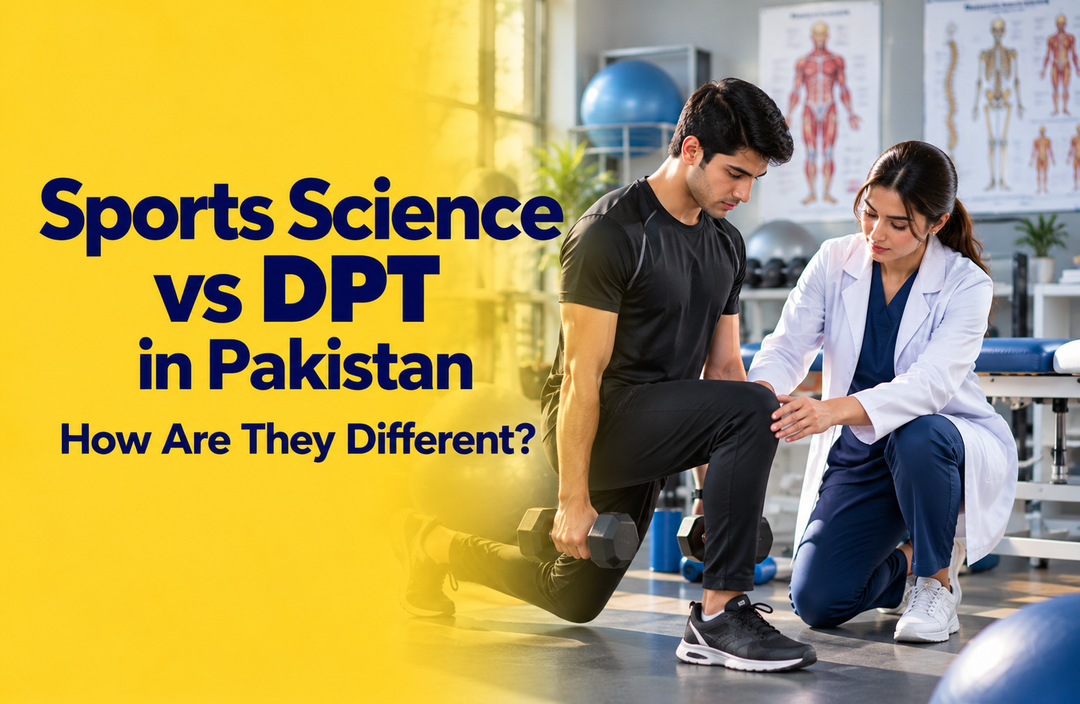
Sports Science vs DPT: What Is the Main Difference?
Sports Science primarily studies performance and physical activity; DPT is professional education in physical therapy and rehabilitation. Both examine the human body, but they ask different questions. A Sports Science student might study how an exercise program affects endurance. A DPT student may study how to assess movement and plan rehabilitation within a clinical framework.
The University of Chenab lists BS Sports Science and Physical Education and Doctor of Physical Therapy.
| Question | Sports Science | DPT |
|---|---|---|
| Main purpose | Understand physical activity, fitness and performance | Assess physical function and study rehabilitation |
| Typical learning | Exercise physiology, coaching, sports psychology, biomechanics | Movement assessment, rehabilitation methods, clinical reasoning |
| Working context | Sport, exercise, education and fitness settings | Clinical rehabilitation and related healthcare settings |
| Professional boundary | Not an automatic physiotherapy qualification | Professional preparation in physical therapy |
| UChenab published DPT duration | Consult Sports Science program page | Five years |
Explore your options: use UChenab’s official degree finder and eligibility information to check the academic route that interests you.
The subjects that sound similar—such as anatomy or biomechanics—are taught for different professional purposes. This is why a degree comparison should examine the applied work, not only course titles.
What Do BS Sports Science Students Study?
Sports Science combines scientific understanding of the body with the study of exercise and sport. The UChenab program description includes anatomy, physiology, kinesiology, biomechanics, sports psychology, nutrition and coaching methods. Students examine how activity is planned and how performance or physical fitness may be evaluated.
For example, a Sports Science assignment might compare training logs or basic performance measures over time. The academic question would concern program planning and interpretation of results. That classroom example is illustrative, not a claim about a specific campus project.
The field also requires ethics, safe exercise supervision and communication. Students should ask how much practical work, observation and research is included in their own course.
What Is Taught in a Doctor of Physical Therapy Program?
Physical therapy education prepares students to study movement problems and rehabilitation through supervised clinical training. Students develop knowledge of anatomy, physiology, assessment and rehabilitation approaches, alongside documentation, clinical reasoning and professional responsibilities.
UChenab’s DPT program page lists five years of full-time study. A long professional course should be evaluated by the quality of learning and supervised experience, not by an assumption that the word “Doctor” is equivalent to an MBBS qualification. Different professions have different legal scopes of practice.
For questions about clinical practice rights or registration, candidates should refer to the relevant professional authority and their program’s current accreditation information.
What Subjects Do Sports Science and DPT Share?
Both disciplines rely on anatomy, physiology and principles of human movement. A student may encounter biomechanics or exercise science in either route. However, shared vocabulary does not make the courses interchangeable.
In Sports Science, biomechanics may be used to understand a running movement or sporting technique. In DPT, movement analysis may form part of a rehabilitation assessment under appropriate clinical supervision. The distinction lies in the professional question, training setting and responsibility assigned to the practitioner.
What About Career Scope in Pakistan?
Career direction follows the qualification and demonstrable skills, not a salary promise. Sports Science graduates may investigate sports education, exercise and fitness-related work, coaching development or further research. DPT graduates may pursue opportunities within physical therapy subject to current licensing and workplace rules.
Do not assume every graduate automatically qualifies for every advertised title. Compare real vacancy criteria, required experience and the professional regulation governing the setting. Practical projects and supervised training can help you demonstrate abilities, but no course guarantees placement.
Should You Choose Sports Science or DPT?
Choose based on whether performance science or clinical rehabilitation is the more compelling study direction.
- Choose Sports Science if you enjoy coaching ideas, exercise planning, movement performance and the science of sport.
- Choose DPT if you are interested in patient assessment, rehabilitation and a clinical professional pathway.
- Investigate both further if you like movement science but have not explored what supervised clinical responsibilities involve.
Ask each department about the curriculum, practical placements, assessment methods and approved intake details. Review UChenab’s eligibility guidance and application steps to plan your next move.
Frequently asked questions
Is a Sports Science graduate a physiotherapist?
No. Studying sports science and physical education does not by itself award the professional qualification required to practice physical therapy. Sports Science and DPT share some knowledge of human movement but have different educational and clinical purposes. Candidates should verify relevant professional registration requirements before planning a patient-treatment career.
Is DPT better than Sports Science in Pakistan?
Neither is universally better. DPT is aimed at physical therapy and rehabilitation, while Sports Science examines exercise, sport, fitness and performance. A student who wants clinical rehabilitation should investigate DPT. Someone more interested in coaching and exercise-related study may prefer Sports Science. The curriculum and professional pathway should decide.
Does Sports Science include anatomy and biomechanics?
Yes. UChenab’s Sports Science and Physical Education overview lists subjects including anatomy, physiology, kinesiology and biomechanics. These help students understand physical movement and exercise. Similar scientific concepts can appear in DPT, but the context changes because physical therapy focuses on clinical assessment and rehabilitation.
How long is the DPT program at UChenab?
The University of Chenab’s DPT program page describes a five-year full-time qualification. Applicants should confirm the latest program information, entry rules and clinical arrangements for their intended intake before making an admission decision. Duration alone does not describe the volume or quality of practical experience.
Can I work in a hospital after studying Sports Science?
Employment depends on the specific role and its qualification requirements. A Sports Science degree should not be assumed to meet criteria for a licensed physiotherapist or another regulated healthcare profession. Review the job description and the applicable professional requirements carefully before choosing an academic route for hospital-based work.
Next step: Check your admission options
Explore the program directory, review admission eligibility and follow the official application instructions when you have selected a suitable course. Current availability, fees and dates are determined by the relevant intake.