
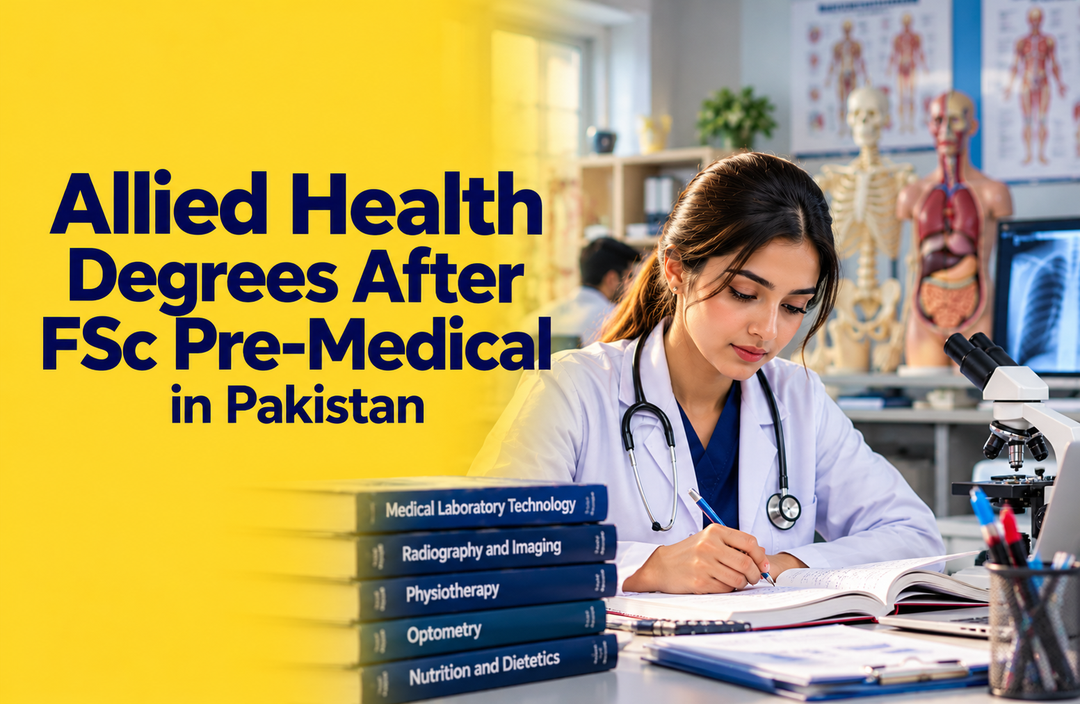
What Can You Study After FSc Pre-Medical Besides MBBS?
Allied health degrees prepare students for specialized work that supports diagnosis, rehabilitation, health assessment and care. Healthcare is a team activity: different professionals contribute different forms of knowledge. Some work largely with laboratory samples, some with imaging equipment, and others have extended direct contact with patients.
At the University of Chenab in Gujrat, students can explore different healthcare-related programs through the undergraduate programs directory and degree finder. The pages are starting points for comparing curricula, not proof that every degree is open for every intake.
| Program area | What students mainly study | A useful question to ask |
|---|---|---|
| Medical Laboratory Technology | Testing and analysis of biological samples | Do I enjoy laboratory procedures and quality control? |
| Radiography & Imaging Technology | Medical imaging, anatomy and safe image acquisition | Would I enjoy working with imaging equipment and patients? |
| Optometry & Vision Sciences | Eyesight assessment, optics and eye care | Am I interested in vision and patient examinations? |
| Doctor of Physical Therapy | Human movement and rehabilitation | Do I want to study movement assessment and physical rehabilitation? |
| Pharm-D | Medicines, pharmacology and pharmaceutical practice | Am I interested in how medicines work and are used safely? |
| Nursing | Clinical nursing care and patient assessment | Am I drawn to direct, continuing patient care? |
| Nutrition & Dietetics | Food, nutrients and their relationship to health | Would I enjoy studying dietary assessment and nutrition science? |
Explore your options: use UChenab’s official degree finder and eligibility information to check the academic route that interests you.
The list represents areas of study, not a guarantee of identical eligibility conditions or professional registration rights.
Laboratory Science or Medical Imaging?
Laboratory programs answer questions through specimens, while imaging programs answer them through images. A student drawn to chemistry and microbiology may prefer BS Medical Laboratory Technology. A student who prefers anatomy, equipment operation and patient positioning can explore Radiography and Imaging Technology.
In both areas, practical training is essential because inaccurate identification, improper technique or weak quality checks can affect clinical evidence. The courses differ in methods, working environment and the role played by the graduate. Ask what laboratory or imaging practical sessions are included in the approved curriculum.
Vision Sciences, Physical Therapy or Nursing?
These fields involve different forms of patient-facing professional education. Optometry focuses on vision assessment and relevant eye-care knowledge. Physical therapy studies movement, physical function and rehabilitation. Nursing focuses on structured nursing care, clinical observations and patient support.
Explore UChenab’s Optometry and Vision Sciences information and its DPT program. Nursing degree routes require special attention to prior qualifications and Pakistan Nursing & Midwifery Council requirements. In particular, a Post-RN route is not the same as a first-entry nursing degree.
None of these courses confers another profession’s license merely because both programs share human anatomy or hospital-based subjects.
What About Pharm-D and Nutrition?
Pharmacy education concerns medicines, while nutrition education investigates food and health. Pharm-D incorporates subjects such as pharmacology, pharmaceutical science and the safe use of medications. Nutrition study examines dietary patterns, metabolism and food-related assessment.
If you enjoy chemistry and want to learn how medicines are developed, prepared, evaluated and used under professional rules, read the Pharm-D program. If your strongest interest is food science and nutrition, compare the relevant programs in the university’s current degree directory.
Professional titles and practice rights are governed by applicable authorities and registration conditions. They should never be inferred from a course name alone.
How to Check Eligibility After FSc Pre-Medical
Eligibility depends on the precise program and the institution’s published admission policy. Do not assume that meeting a general university minimum automatically meets every nursing, pharmacy or other regulated-program condition.
- Shortlist two or three fields based on the scientific work that interests you.
- Read each program’s subjects and practical-training requirements.
- Check official eligibility criteria and accepted qualifications.
- Ask which professional-body requirements apply to the specific degree.
- Check the latest fees, program status and application schedule through the official admission channels.
A-Level candidates may need an IBCC equivalence certificate for local admission assessment, depending on their qualification and the applicable rules.
How to Choose an Allied Health Degree Without Guessing
Choose a degree by considering the daily work, scientific subjects and professional path together. Be cautious of lists that describe a program as “best” because of an unsupported salary figure. Instead, examine sample coursework, learning facilities, clinical supervision, professional pathways and your own interests.
For students from Gujrat, Gujranwala, Sialkot and neighboring districts, the University of Chenab’s campus location may also affect daily travel or accommodation decisions. A practical budget should consider the entire course, not just the first semester’s fee.
When you have a shortlist, review how to apply at UChenab and confirm that your selected program is accepting applications for your intended intake.
Frequently asked questions
Which allied health degree is best after FSc Pre-Medical?
There is no universally best allied health degree. Medical Laboratory Technology, Radiography, Optometry, Physical Therapy, Nursing, Pharmacy and Nutrition involve different scientific interests and workplace responsibilities. Start with the curriculum and practical tasks you would enjoy, then verify admission conditions and any professional registration requirements for the exact qualification.
Can I study allied health without taking MDCAT?
There is no single entry-test rule covering every allied health degree and university in Pakistan. The required tests depend on the program, current regulations and institutional admission policy. Check the relevant UChenab admission criteria rather than relying on general online claims that MDCAT is always necessary or never required.
What is the difference between MLT and Radiography?
MLT primarily studies the testing of blood and other biological samples, while Radiography trains students in medical image acquisition and related patient safety. Both provide evidence used by clinical teams, but the equipment and technical procedures differ. The correct choice depends on whether laboratory investigation or medical imaging interests you.
Can an FSc Pre-Medical student apply for Pharm-D?
FSc Pre-Medical is a relevant preparation for pharmacy education. However, admission depends on the current university requirements and any professional regulations for the particular intake. Review the Pharm-D program page and obtain confirmation of entry conditions before preparing documents or assuming that a specific percentage is sufficient.
How should parents compare allied health programs?
Parents can compare the actual subjects, supervised practical opportunities, duration, full study costs and professional recognition requirements. Ask what kind of work a graduate is trained to perform and how competence is assessed. Avoid judging by degree titles, unverified job-placement claims or isolated salary stories shared on social media.
Next step: Check your admission options
Explore the program directory, review admission eligibility and follow the official application instructions when you have selected a suitable course. Current availability, fees and dates are determined by the relevant intake.